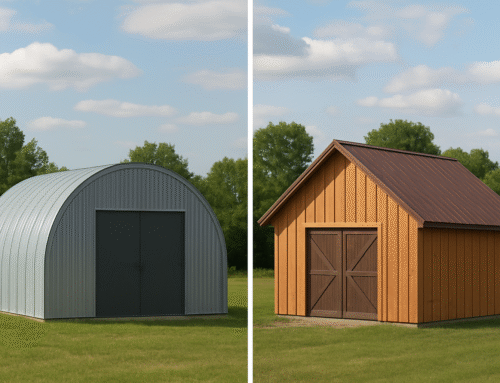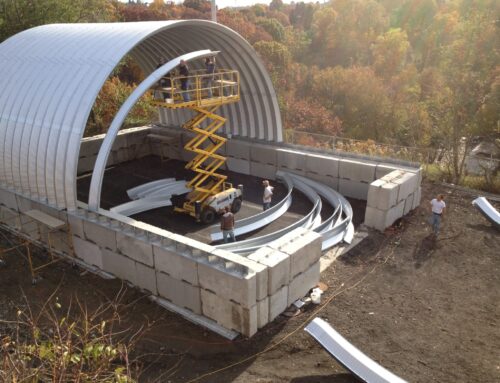
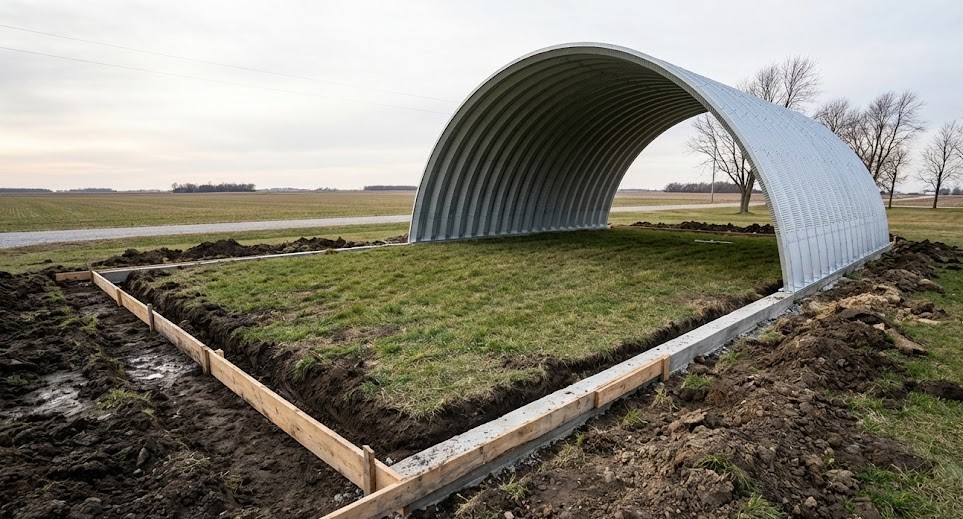
Choosing the right foundation for your Quonset hut determines how long your building lasts and how well it performs over time. Whether you’re considering a gravel pad for its simplicity and low cost in light-duty or temporary applications, or a concrete slab foundation for permanent projects requiring maximum durability, understanding your quonset hut foundation options is essential. In cold climates, frost-protected and insulated foundations help prevent shifting and structural damage caused by freeze-thaw cycles. Regardless of which foundation type you select, proper site preparation—including adequate drainage, correct grading, and thorough soil compaction—provides the stability your arch building needs. Continue reading to learn about each foundation type, detailed site preparation steps, and local code requirements so you can plan your Quonset hut project with confidence.
Permits, Codes & Engineering Requirements
Before installing your foundation, local authorities will review your building plans. This typically includes checking setbacks, utilities, drainage, and foundation specifications. Many jurisdictions require stamped engineering drawings for foundation designs. Common inspection points include excavation, rebar/vapor barrier installation, and final approval.
Drainage & Grading Requirements
Why proper drainage matters: Water damage is the primary threat to any foundation system. Correct grading prevents settlement, saturation, and frost heave that can compromise your structure.
Standard grading requirements (IRC R401.3):
Grade must slope ≥6″ within 10′ from your foundation (≈2% slope). When space constraints prevent proper grading, redirect water using approved drainage systems like French drains or swales.
Drainage solutions for tight spaces:
- Install shallow swales along property lines
- Add French drains with perforated pipe sloped to daylight
- Ensure walkways slope away from the building
- Eliminate flat spots near entrances
Common drainage mistakes:
- Negative grading toward the foundation
- Downspouts discharging directly onto the pad
- Sidewalks pitched toward the building
- Poor drainage at door openings
Soil Preparation Standards
Soil compaction requirements: Proper soil preparation is essential for any foundation. Standard specifications call for ≥95% of Standard Proctor density (ASTM D698) with field testing to verify compaction levels.
Best practices: Build up your base in thin lifts, maintain optimal moisture content, and compact each layer thoroughly. For problematic soils like expansive clays or high water tables, engage a geotechnical engineer before selecting your foundation type.
Quonset Hut Foundation Options: Complete Comparison
The right foundation depends on your climate, intended use, and local building codes. Here are the main options with planning guidelines:
1) Concrete Slab Foundation
- Best for: Permanent installations requiring durable, cleanable floors
- Specifications: 4″ minimum thickness with 2500-2800 psi concrete for light use; 6″ thickness with 4000 psi concrete for heavy equipment
- Reinforcement: #3 rebar at 24″ O.C. or fiber mesh per engineering design
- Moisture protection: 6-10 mil vapor barrier over compacted gravel base
- Pros: Long-term durability, finished surface, pest resistance
- Cons: Higher initial cost, weather-dependent installation
2) Thickened-Edge Foundation (Monolithic)
- Best for: Cold climates requiring integral footings with slab
- Features: Single-pour construction with thickened perimeter edge
- Notes: Often includes perimeter insulation in frost zones; requires engineering design
- Advantage: Eliminates separate footing construction
3) Floating Slab & FPSF Systems
- Concept: Frost-Protected Shallow Foundation keeps footings above frost line using strategic insulation
- Code reference: IRC R403.3 governs FPSF design
- Requirements: Heated buildings must maintain ≥64°F average temperature
- Design resources: HUD FPSF Design Guide and ASCE 32
- Ideal for: Arch buildings like AgriBilt systems with engineered drawings
4) Gravel Pad Foundation
- Best for: Budget-conscious projects, temporary installations, or light storage
- Construction: Compacted aggregate base with proper drainage
- Pros: Low cost, fast installation, excellent drainage, easy modification
- Cons: No finished floor, requires maintenance, potential for pest infiltration
- Note: Can be upgraded to concrete later with proper planning
Quonset Hut Foundation Options Comparison
| Foundation Type | Cost | Installation Speed | Engineering Required | Moisture Control | Long-term Durability |
| Gravel pad | Low | Fast | Minimal | Excellent | Moderate |
| 4″ concrete slab | Medium | Medium | Standard | Good | High |
| 6″ concrete slab | Med-High | Medium | Standard | Good | Very High |
| Thickened-edge | Medium | Medium | Yes | Good | Very High |
| FPSF floating | Medium | Medium | Required | Good | Very High |
All concrete foundation options require vapor barriers and proper drainage per IRC R401.3.
Cold Climate Considerations
In frost-prone areas, your foundation must address freeze-thaw cycles. Three main approaches:
- Traditional footings below frost line – Most conservative approach
- FPSF with insulation strategy – Uses perimeter and wing insulation to control frost
- Insulated monolithic designs – Where code permits and engineering approves
FPSF explained: This foundation system uses strategic insulation placement to prevent frost penetration, utilizing building heat and geothermal energy to maintain above-freezing soil temperatures near the structure.
Energy code compliance: Many regions require slab-edge insulation based on IECC climate zones. R-values and insulation depths vary by zone and building use.
Choosing your cold-climate approach:
- Heated building? → Consider FPSF or insulated monolithic design
- Unheated building? → Check local code for FPSF allowances or plan for below-frost footings
- Problem soils? → Consult geotechnical engineer for specialized systems
Site Access & Construction Planning
- Delivery access: Ensure clear path for materials delivery – no overhead obstructions or weight restrictions
- Work space: Allow 10-12′ clearance around your building perimeter
- Equipment needs: AgriBilt arch systems require no cranes – perfect for DIY installation with proper preparation
Frequently Asked Questions
What’s the best foundation for my quonset hut?
The optimal choice depends on climate, intended use, and budget. Concrete slabs offer the best long-term value for permanent installations, while gravel pads work well for temporary or budget projects. FPSF systems excel in cold climates for heated buildings.
Do I need footings below frost line?
Not necessarily. Many cold-climate projects use engineered FPSF designs per IRC R403.3 that place footings above frost line with proper insulation. Your engineer and local building official determine the approved approach.
What drainage slope is required around my building?
Minimum 6″ drop within 10′ from the foundation (≈2% slope) per IRC R401.3. Use drainage systems like French drains where space doesn’t permit proper grading.
How much should I compact the base?
Standard specification is 95% of Standard Proctor density (ASTM D698). Your engineer may specify different targets based on soil conditions and building loads. Always verify with field density testing.
Can I use gravel as my foundation?
Yes, gravel makes an excellent foundation for many applications. It’s economical, drains well, and installs quickly. However, it doesn’t provide a finished floor and may require more maintenance than concrete options.
What concrete thickness do I need?
Planning guidelines: 4″ thickness with 2500-2800 psi concrete for light vehicles; 6″ thickness with 4000 psi concrete for heavy equipment. Always confirm specifications with your structural engineer.
Selecting Your Foundation: Decision Guide
Climate considerations:
- Frost zone + heated use → Investigate FPSF or insulated monolithic options
- Mild climate → Standard slab or well-designed gravel pad may suffice
Use and loading:
- Light storage/budget project → Start with gravel pad, upgrade later if needed
- Workshop/vehicle storage → 4-6″ concrete slab with appropriate reinforcement
Site conditions:
- Wet or poor soils → Prioritize drainage improvements and consider geotechnical consultation
- Fast timeline → AgriBilt arches with floating slab offer quickest installation
Budget and permanence:
- Temporary/budget → Gravel pad foundation
- Permanent/high-use → Concrete slab foundation
- Cold climate/heated → FPSF system
Remember: While these guidelines help with initial planning, your final foundation design must be approved by a licensed engineer and your local building department. Always obtain stamped drawings and proper permits before beginning construction.