Quonset hut condensation happens when warm, humid air inside meets the cool steel panels, causing water droplets to form. The best way to stop it is to control both the air and the surface. That means combining proper ventilation (intake low, exhaust high) with a moisture barrier or insulation to prevent the steel from cooling the air to its dew point. Add ground moisture control and cross-ventilation, and most dripping will disappear within weeks.
Why Quonset Huts ‘Sweat’
Your arch-steel building creates the perfect storm for moisture problems. Here’s the building science behind Quonset hut sweating:
The Dew Point Effect: When warm, humid air touches steel panels that are cooler than the air’s dew point temperature, water vapor instantly condenses into droplets. Think of it as invisible moisture in the air becoming visible water on your roof and walls.
Arch Geometry Concentrates Problems: The curved design channels condensation down to panel seams and low points. Unlike peaked roofs that shed water to gutters, arch buildings collect drips right where you’re storing equipment or working.
Ground Moisture Rises: Concrete slabs without proper vapor barriers allow soil moisture to evaporate upward. This invisible humidity source can overwhelm even sound ventilation systems, especially during temperature swings.
Temperature Cycling: Steel panels heat up during the day and cool rapidly at night or when the weather changes. This constant temperature cycling creates ideal conditions for repeated condensation cycles.
The problem worsens when you store wet equipment, run welding operations, or house livestock—all activities that pump extra moisture into an already humid environment.
Ventilation That Works on Arch Steel
Effective Quonset hut ventilation follows simple physics: move air in low, out high, and create cross-flow patterns that prevent dead spots.
Passive Airflow Systems
Ridge and Soffit Strategy: Install continuous ridge vents at the building’s peak and soffit or eave intakes along the sides. This creates a natural stack effect. Warm air rises and escapes while cooler outside air enters low.
Wall Louvers for Cross-Ventilation: Add louver vents on opposite walls, positioned at different heights. This creates horizontal airflow that prevents moisture pockets in corners and equipment areas.
Turbine Vents: Wind-powered turbines work well on arch roofs but need consistent breezes. They’re most effective when paired with adequate intake vents-a turbine without proper intake just fights itself.
When to Add Powered Exhaust
Consider exhaust fans when passive ventilation can’t keep up:
- High-moisture activities: Welding shops, wash bays, livestock areas
- Still-air locations: Buildings in valleys or wind-blocked areas
- Large spaces: Buildings over 40 feet wide, where natural circulation struggles
CFM Sizing Rule: Calculate your building’s volume (length × width × height), then multiply by your target air changes per hour (ACH). Divide by 60 for CFM requirements.
Example: 40′ × 60′ × 16′ = 38,400 cubic feet For 4 ACH: 38,400 × 4 ÷ 60 = 2,560 CFM needed
Insulation & Moisture Barriers for Curved Panels
The right thermal strategy eliminates the temperature differential that causes condensation. Here are your three main options:
Closed-Cell Spray Foam
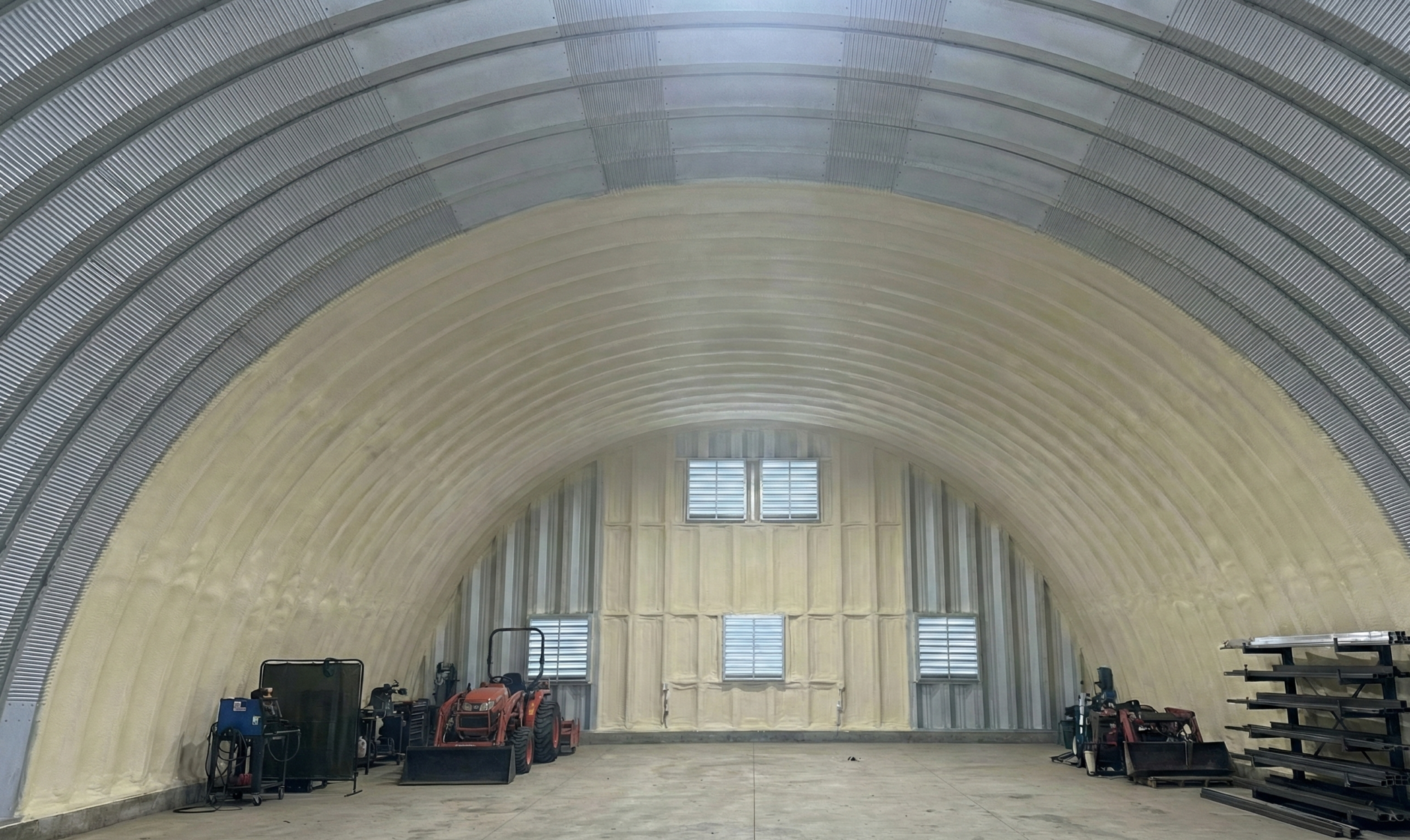
The best overall solution for Quonset hut condensation control is spray foam. In one application, it creates an air seal and thermal break, conforming perfectly to curved panels.
- Pros: Eliminates thermal bridging, stops air leaks, adds structural strength
- Cons: Higher upfront cost, requires professional installation
- Best for: New builds or major retrofits where long-term performance justifies cost
Fiberglass with Smart Vapor Barrier
When properly detailed, it is a cost-effective option. Use unfaced fiberglass batts with a separate vapor barrier positioned toward the warm side.
- Critical details: Seal all seams, penetrations, and panel joints. Poor vapor barrier installation can trap moisture and create bigger problems.
- Best for: Budget-conscious projects with skilled installers
Anti-Condensation Membranes
Factory-applied membranes like DripStop absorb moisture during condensation events, then re-evaporate it when conditions reverse.
- How it works: Felt backing absorbs up to one gallon per 100 square feet, releasing moisture back to the air when panels warm up.
- Pros: Factory installation ensures quality, works immediately, and no thickness loss
- Cons: Limited capacity, needs proper ventilation to work effectively
- Best for: New construction in moderate climates
| Solution | Cost | Install Complexity | Retrofit-Friendly | Performance |
| Spray Foam | $$$ | Professional | Difficult | Excellent |
| Fiberglass + Barrier | $ | Moderate | Good | Good (if detailed) |
| Anti-Condensation | $$ | Factory Only | No | Good |
Ground, Slab & Site Moisture Control
Even perfect ventilation can’t overcome ground moisture problems. Address these sources first:
Sub-Slab Vapor Barrier: Install 6-mil polyethylene under concrete slabs, overlapping seams 6 inches and sealing with tape. This single step eliminates most ground-sourced humidity.
Perimeter Sealing: Seal gaps between slabs and wall panels with quality caulk or foam. Small cracks let surprising amounts of ground moisture enter.
Site Drainage: Grade soil away from the building and install gutters if needed. Wet soil around your foundation creates a constant moisture source that overwhelms any ventilation system.
Existing Slabs: If you can’t retrofit under-slab barriers, use penetrating concrete sealers and ensure excellent ventilation to handle moisture migration.
Quick Sizing: How Much Ventilation Do I Need?
Use this simple formula to size your Quonset hut ventilation system:
CFM = Building Volume × ACH ÷ 60
Recommended Air Changes per Hour (ACH):
- Storage/warehouse: 2-4 ACH
- Workshop/garage: 4-6 ACH
- Welding shop: 6-10 ACH
- Livestock: 4-8 ACH (varies by animal density)
Sample Calculation: Building: 30′ × 80′ × 14′ = 33,600 cubic feet Workshop use: 33,600 × 5 ACH ÷ 60 = 2,800 CFM
Size the intake area 25% larger than the exhaust to prevent negative pressure that could pull ground moisture through cracks.
Retrofit vs New Build Considerations
Easiest Retrofit Additions:
- Wall louver vents (cut openings, install with gaskets)
- Exhaust fans in end walls
- Turbine vents (though ridge cutting requires care)
- Ground-level moisture barriers around the building perimeter
Worth Specifying on New Orders:
- Factory-applied anti-condensation membranes
- Pre-installed ridge vent systems
- Soffit/eave intake strips
- Insulation attachment systems
Planning Tip: Adding ventilation after construction costs 2-3 times more than factory installation. If you’re unsure about future needs, spec the roof penetrations and cap them. You can always add fans later.
Maintenance & Seasonal Checklist
Spring Inspection:
- Clear debris from intake and exhaust vents
- Check membrane edges for damage or loose sections
- Test exhaust fans and clean blades
- Inspect caulk around penetrations
Fall Preparation:
- Clean the louver vents of leaves and dust
- Verify insulation hasn’t shifted or compressed
- Check for new rust spots (early condensation warning)
- Adjust fan timer controls for winter operation
Monthly Checks:
- Keep 3-foot clearance around intake vents
- Monitor for new moisture stains or mildew
- Ensure stored materials don’t block airflow paths
FAQs
Will vents alone stop Quonset hut condensation?
Ventilation reduces moisture but won’t eliminate condensation if there are large temperature differences. For best results, combine vents with insulation or moisture barriers.
Do I need a dehumidifier if I add spray foam?
Spray foam typically eliminates condensation, so dehumidifiers are rarely needed unless you have high-moisture activities like welding or washing equipment.
Where do ridge vents go on an arch roof?
Install continuous ridge vents at the highest point of the arch. For Quonset huts, this runs along the entire building length at the crown of the curve.
Can I retrofit an anti-condensation membrane?
No, membranes like DripStop must be factory-applied during panel manufacturing. Retrofit solutions focus on ventilation and insulation.
How much does Quonset hut ventilation cost?
Basic passive ventilation (louvers and ridge vents) runs $2-5 per square foot. Depending on CFM requirements, powered exhaust systems add $8-15 per square foot.
Stop Condensation for Good
Solving Quonset hut condensation requires addressing three factors: ventilation, thermal control, and moisture sources. Start with proper intake and exhaust ventilation, add insulation or moisture barriers to break the temperature cycle, and control ground moisture around your building.
The result? Dry, rust-free storage that protects your equipment and maintains property value year after year.
Ready to eliminate moisture problems? Compare vent options and anti-condensation solutions, or get a no-pressure quote for your specific building.